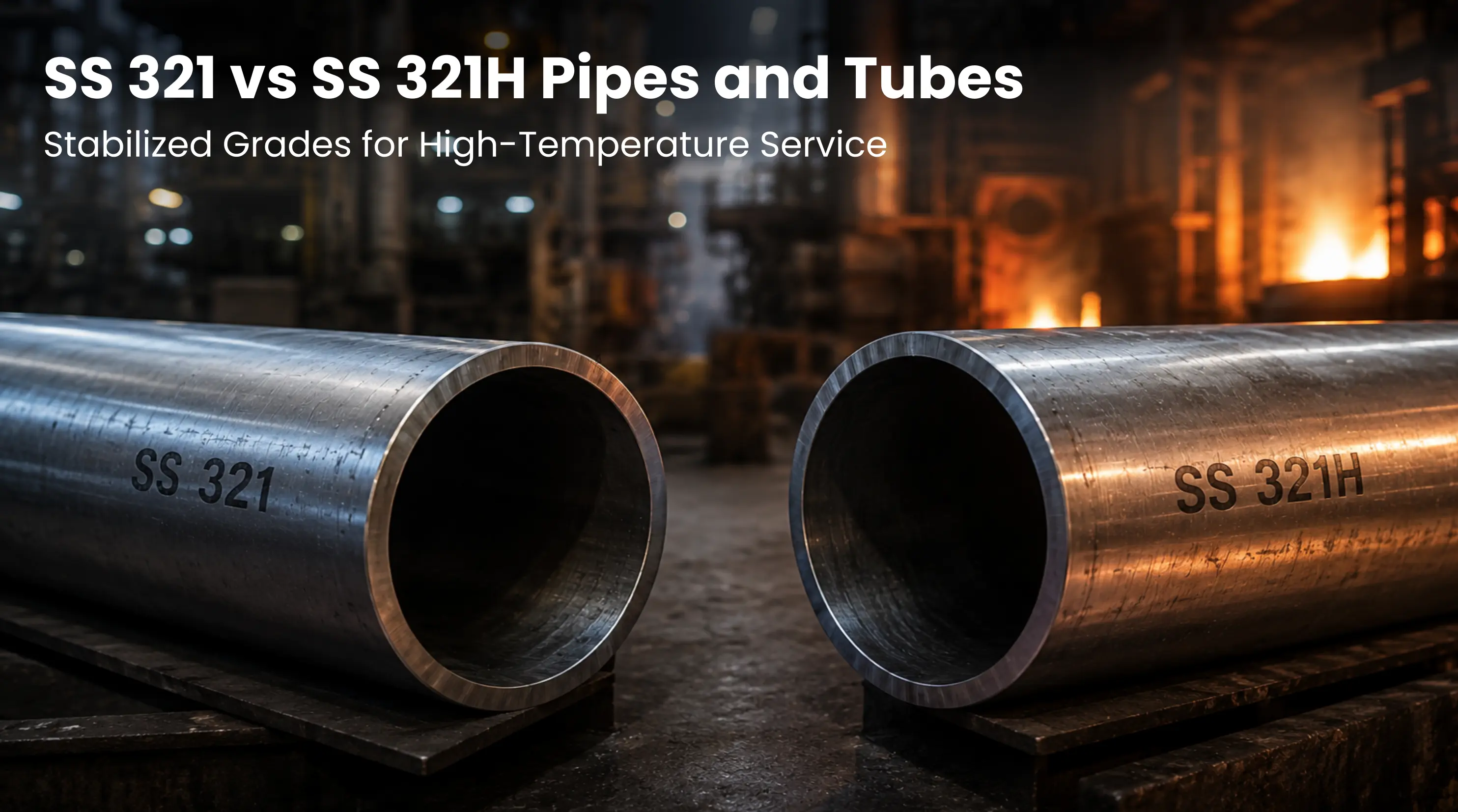
SS 321 vs SS 321H Pipes and Tubes: Stabilized Grades for High-Temperature Service
When selecting stainless steel for elevated-temperature applications, engineers often compare SS 321 vs SS 321H Pipes and Tubes. Although both belong to the same titanium-stabilized austenitic stainless steel family, they are designed for different operating conditions.
If your project involves heat exchangers, industrial furnaces, aerospace ducting, refinery piping, or exhaust systems, understanding the differences between these grades can improve equipment reliability, service life, and maintenance costs.
This guide explains how SS 321 and SS 321H differ, why titanium stabilization matters, and how to choose the right material for high-temperature service.
What Does Stabilized Stainless Steel Mean?
The term stabilized stainless steel refers to grades that contain alloying elements capable of preventing chromium carbide precipitation during welding or prolonged exposure to elevated temperatures.
In SS 321 Pipes and Tubes this stabilization is achieved by adding titanium (Ti).
Titanium exhibits a greater chemical affinity for carbon than chromium, preferentially forming stable titanium carbides and thereby inhibiting the formation of chromium carbides. Instead of allowing chromium carbides to form at grain boundaries, titanium combines with carbon to create stable titanium carbides.
This offers several advantages:
Unlike SS 304, which may require post-weld heat treatment in certain applications, SS 321 generally performs well without additional stabilization processes.
SS 321 vs SS 321H Pipes and Tubes: What's the Difference?
Although both grades contain titanium stabilization, the main distinction lies in carbon content.
| Property | SS 321 | SS 321H |
|---|---|---|
| Carbon Content | Lower | Higher |
| Titanium Stabilization | Yes | Yes |
| High Temperature Strength | Very Good | Excellent |
| Creep Resistance | Good | Superior |
| Long-Term Heat Exposure | Suitable | Preferred |
| Pressure Vessel Applications | Good | Better |
The increased carbon level improves:
For industries operating continuously at elevated temperatures, SS 321H often becomes the preferred choice.
Why the H-Suffix Matters in High-Temperature Service
Many industrial applications involve prolonged service under elevated-temperature conditions, commonly ranging from 500°C to 900°C, where material stability and creep resistance become critical design considerations.
At these temperatures, materials experience gradual deformation known as creep.
Creep may not be immediately visible, but over thousands of operating hours it can lead to:
Owing to their higher carbon content, SS 321H Pipes and Tubes exhibit enhanced mechanical strength and creep resistance at elevated temperatures while retaining the benefits of titanium stabilisation, which suppresses chromium carbide precipitation and preserves corrosion resistance.
Typical high-temperature services include:
Where continuous heat exposure is expected, engineers frequently specify SS 321H instead of standard SS 321.
SS 321 vs SS 347: Which Stabilized Grade Is Better?
Another common comparison is SS 321 vs SS 347.
While both are stabilized stainless steels, they use different stabilizing elements.
| Feature | SS 321 | SS 347 |
|---|---|---|
| Stabilizing Element | Titanium | Niobium (Columbium) |
| Weldability | Excellent | Excellent |
| Intergranular Corrosion Resistance | High | High |
| High Temperature Performance | Excellent | Excellent |
| Heavy Welding Applications | Very Good | Often Preferred |
| Availability | Widely Available | Project-specific |
Choose SS 321 when:
Choose SS 347 when:
Both grades perform exceptionally well, but project specifications usually determine the preferred option.
Common Applications of SS 321 and SS 321H Pipes and Tubes
Both grades are widely used wherever high temperature and corrosion resistance are required.
Exhaust Systems
Automotive, marine, and industrial exhaust systems experience repeated heating and cooling cycles. Titanium stabilization helps maintain corrosion resistance even after welding.
Aerospace Ducting
Aircraft engine ducting and exhaust components demand lightweight materials capable of handling thermal expansion without losing structural integrity.
Heat Exchangers
Heat exchanger tubing often encounters continuous temperature fluctuations. SS 321 provides excellent oxidation resistance and long service life.
Furnace Components
Industrial furnaces rely on stabilized stainless steel tubing to resist oxidation and maintain strength during prolonged exposure to heat.
Petrochemical Plants
Process piping carrying high-temperature fluids benefits from the improved creep resistance of SS 321H.
Expansion Joints
Thermal expansion systems require materials that resist cracking under repeated thermal stress.
Sourcing and Certification Notes for GCC Buyers
Buyers across the UAE, including Dubai, Abu Dhabi, Sharjah, Ajman, Ras Al Khaimah, Fujairah, and Al Ain, typically require complete material documentation and traceability before approving stainless steel pipes and tubes for industrial projects.
When sourcing SS 321 or SS 321H Pipes and Tubes, request:
Conclusion
Choosing between SS 321 vs SS 321H Pipes and Tubes depends primarily on operating temperature, service duration, and mechanical loading.
SS 321 provides outstanding weldability, oxidation resistance, and protection against intergranular corrosion, making it an excellent choice for many high-temperature applications. When equipment will operate continuously at elevated temperatures under sustained stress, SS 321H offers enhanced creep strength and long-term structural reliability.
For projects across the GCC and other industrial markets, selecting the correct stabilized stainless steel grade—supported by proper certifications and quality documentation—helps ensure safer operations, longer service life, and reduced maintenance costs.
Frequently Asked Questions
1. Is SS 321 better than SS 304 for high-temperature applications?
Yes. SS 321 Pipes and Tubes are generally a better choice than SS 304 for high-temperature applications because they contain titanium, which stabilizes the stainless steel and minimizes chromium carbide precipitation during welding and prolonged exposure to temperatures between approximately 425°C and 900°C. This improves resistance to intergranular corrosion, maintains corrosion resistance after welding, and extends service life in heat exchangers, exhaust systems, furnace components, and industrial process piping.
2. Why is SS 321H used instead of SS 321?
SS 321H Pipes and Tubes are selected when equipment operates continuously at elevated temperatures where higher mechanical strength is required. The "H" designation indicates a higher carbon content, which enhances creep strength, stress rupture resistance, and long-term structural stability during prolonged service above approximately 500°C. Industries such as power generation, petrochemicals, refineries, and thermal processing often specify SS 321H for high-temperature pressure systems.
3. Can SS 321 Pipes and Tubes be welded without losing corrosion resistance?
Yes. SS 321 Pipes and Tubes offer excellent weldability because titanium binds with carbon to form stable titanium carbides instead of chromium carbides. This reduces the risk of sensitization and intergranular corrosion in the heat-affected zone after welding. In most applications, SS 321 maintains its corrosion resistance without requiring post-weld heat treatment, making it a preferred material for fabricated high-temperature equipment and welded piping systems.
4. Which is better for refinery piping: SS 321 or SS 321H?
The selection depends on the operating temperature and service conditions. SS 321 is suitable for many high-temperature refinery applications involving intermittent heat exposure and welded components. However, SS 321H Pipes and Tubes are generally preferred for continuous high-temperature refinery piping because their higher carbon content provides improved creep resistance, better stress rupture strength, and greater long-term reliability under sustained thermal loads. Material selection should always comply with the project's design code, operating temperature, pressure requirements, and applicable ASTM or ASME specifications.
5. Is SS 347 a replacement for SS 321 Pipes and Tubes?
Not necessarily. Both SS 321 and SS 347 Pipes and Tubes are stabilized austenitic stainless steels designed to resist intergranular corrosion after welding, but they use different stabilizing elements. SS 321 is widely used for aerospace components, automotive exhaust systems, and applications involving repeated thermal cycling. SS 347 is often specified for pressure vessels, heavy welded assemblies, and chemical or power plant equipment where niobium stabilization and certain design codes are preferred. The appropriate grade should be selected based on operating temperature, welding requirements, applicable standards, and project specifications.

Our Location
Flat no 5, Swapna HSG Soc
Ltd., Charkop, Kandivali West,
Mumbai, Maharashtra, India.
400067