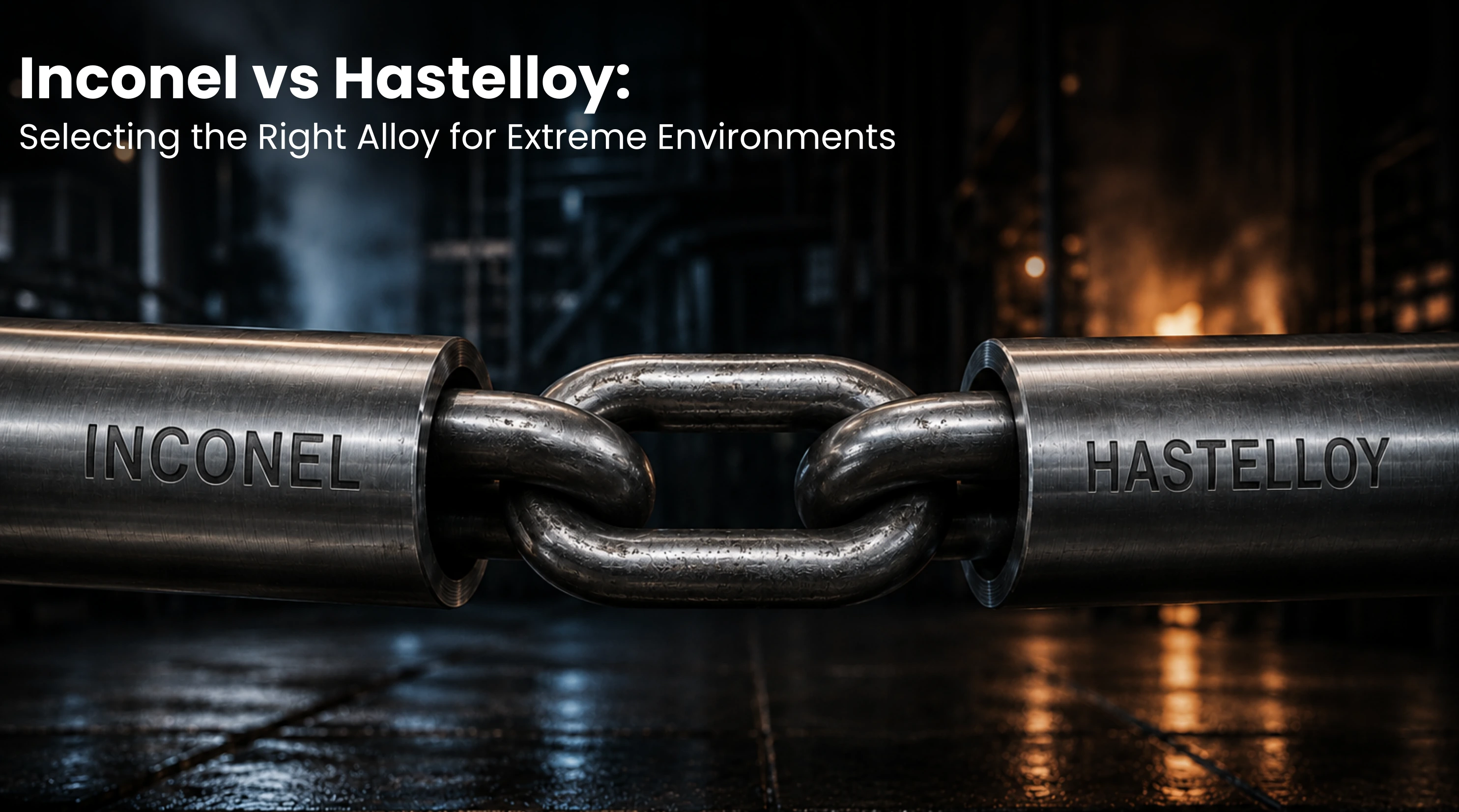
Inconel vs Hastelloy: Selecting the Right Alloy for Extreme Environments
In industries where equipment is continuously exposed to extreme temperatures, aggressive chemicals, high pressures, and corrosive process conditions, material selection becomes a critical engineering decision. Among the most trusted nickel-based alloys, Inconel and Hastelloy are frequently compared due to their exceptional performance in demanding industrial applications.
If you are evaluating Inconel vs Hastelloy, understanding the differences in corrosion resistance, temperature capability, mechanical strength, and application suitability can help you choose the most effective alloy for long-term operational reliability.
Which metallurgical and operational factors distinguish Inconel from Hastelloy when selecting nickel-based alloys for corrosion-intensive and high-temperature engineering applications?
The primary difference between Inconel and Hastelloy lies in their intended performance characteristics.
Inconel is a nickel-chromium-based superalloy primarily developed for elevated-temperature environments. It excels in oxidation resistance, thermal stability, and mechanical strength at high temperatures.
It is a nickel-molybdenum-chromium alloy family specifically engineered to resist aggressive chemical attack, acidic environments, and localized corrosion mechanisms.
While both materials belong to the nickel alloy category, they are optimized for different industrial challenges.
Inconel Alloy vs Hastelloy Alloy: Material Composition
Inconel
Inconel grades such as Inconel 600, 625, 718, and 825 contain:
These characteristics make Inconel highly effective in thermal and pressure-intensive environments.
Hastelloy
Hastelloy grades, notably C22 and C276, are characterized by a highly alloyed nickel-molybdenum-chromium matrix incorporating carefully engineered compositional enhancements to withstand severe corrosive and chemically aggressive service environments:
This alloy family is specifically developed for chemically aggressive service conditions.
High Temperature Alloy Comparison
Which Alloy Performs Better at Elevated Temperatures?
When considering a high temperature alloy comparison, Inconel generally demonstrates superior performance.
Why is Inconel preferred for extreme heat applications?
Inconel maintains exceptional mechanical strength and oxidation resistance even under prolonged exposure to elevated temperatures. This makes it a preferred material for:
Its ability to resist scaling and thermal degradation ensures long-term service reliability.
Inconel for Extreme Heat Applications
Industries operating at elevated temperatures often select Inconel because of its ability to maintain:
For heat-intensive applications, Inconel frequently becomes the first-choice alloy.
Hastelloy Corrosion Resistance vs Inconel
Which Alloy Performs Better in Corrosive Environments?
When comparing Hastelloy corrosion resistance vs Inconel, it generally offers superior protection against aggressive chemical media.
Why is Hastelloy preferred for aggressive chemical environments?
The high molybdenum content within Hastelloy significantly improves resistance to:
These properties make it’s exceptionally valuable in industries where corrosion is the primary operational challenge.
Hastelloy for Aggressive Chemical Environments
It is is widely utilized in:
Its outstanding corrosion resistance helps reduce maintenance costs and improve equipment lifespan.
Inconel or Hastelloy for chemical processing?
The answer depends on the process environment.
If the application involves:
Inconel is often the preferred solution.
However, if the process involves:
Hastelloy typically provides better performance.
Selecting the correct alloy requires evaluating both thermal and corrosion-related factors.
Best Alloy for Corrosive Environments
Which alloy is better: Inconel or Hastelloy?
There is no universal answer because each alloy addresses different engineering challenges.
For highly corrosive process conditions:
✅ Generally offers superior corrosion resistance.
For extreme temperature environments:
✅ Inconel usually delivers better thermal performance.
Therefore, the best alloy for corrosive environments is often Hastelloy, while Inconel remains the preferred option for heat-intensive applications.
Industries That Use Inconel and Hastelloy
Inconel Applications
Hastelloy Applications
Both alloys play critical roles in ensuring operational reliability within extreme industrial environments.
Conclusion
When evaluating Inconel vs Hastelloy, the decision should be based on the specific operating conditions of your application. Inconel excels in high-temperature environments where thermal stability and mechanical strength are essential, while Hastelloy provides exceptional protection against severe chemical corrosion and acidic process conditions. Understanding these distinctions allows engineers, procurement specialists, and plant operators to select the most appropriate alloy for maximizing performance, reliability, and long-term asset value in extreme industrial environments.
Frequently Asked Questions
What fundamental metallurgical distinctions differentiate Inconel and Hastelloy alloys with respect to their corrosion resistance mechanisms, thermal stability, and application-specific performance characteristics?
Although both Inconel and Hastelloy are nickel-based superalloys engineered for demanding industrial service conditions, they are optimized for different performance objectives. Inconel derives its strength from a nickel-chromium alloy matrix that provides exceptional oxidation resistance, thermal stability, and mechanical integrity under elevated temperatures. Consequently, Inconel is generally preferred for high-temperature applications, whereas Hastelloy is extensively specified for corrosion-intensive chemical processing environments.
Which alloy demonstrates superior suitability for chemical processing applications?
Hastelloy is widely regarded as the preferred alloy for chemical processing systems exposed to highly corrosive media, including sulfuric acid, hydrochloric acid, phosphoric acid, chlorides, and oxidizing or reducing chemicals. Its advanced nickel-molybdenum-chromium metallurgy provides exceptional resistance to localized corrosion mechanisms, ensuring prolonged operational reliability in reactors, scrubbers, heat exchangers, and process piping networks operating under severe chemical service conditions.
Can Inconel withstand higher operating temperatures than Hastelloy?
Yes. Inconel alloys are specifically engineered to maintain mechanical strength, oxidation resistance, creep resistance, and metallurgical stability during prolonged exposure to elevated temperatures. Their ability to resist thermal degradation and scaling makes them particularly suitable for gas turbines, aerospace components, industrial furnaces, thermal processing equipment, and other applications where extreme heat resistance is a primary requirement.
Is Hastelloy inherently more corrosion resistant than Inconel?
In chemically aggressive environments, Hastelloy generally exhibits superior resistance to localized corrosion phenomena, including pitting, crevice corrosion, stress corrosion cracking, and acid-induced degradation. Its highly alloyed microstructure enables exceptional performance in chloride-bearing and acidic process streams where conventional high-temperature alloys may experience accelerated corrosion. As a result, Hastelloy is frequently selected for applications where corrosion mitigation is a more critical design consideration than elevated-temperature strength.

Our Location
Flat no 5, Swapna HSG Soc
Ltd., Charkop, Kandivali West,
Mumbai, Maharashtra, India.
400067