Industrial piping systems rely on more than pipes alone. Every change in direction, flow division, pipe size, or pipeline termination requires a fitting specifically engineered to maintain pressure integrity and uninterrupted fluid movement. Understanding Buttweld Fitting Types is therefore essential for engineers, procurement specialists, EPC contractors, and plant operators responsible for designing safe and efficient piping networks.
Manufactured in accordance with internationally recognised standards such as ASME B16.9, buttweld fittings are permanently welded to adjoining pipes, creating strong, leak-resistant joints suitable for high-pressure and high-temperature applications. Whether installed in refineries, petrochemical facilities, power plants, offshore platforms, or water treatment systems, selecting the correct fitting type directly influences hydraulic efficiency, equipment lifespan, and maintenance requirements.
Why Fitting Type Affects Flow and System Reliability
Every piping system is designed to transport liquids, gases, or steam with minimal pressure loss while maintaining structural integrity. Choosing the wrong fitting can increase turbulence, accelerate erosion, create excessive pressure drops, and reduce operational efficiency.
Properly selected Buttweld Fitting Types help:
Engineers evaluate factors such as operating pressure, temperature, pipe diameter, flow velocity, corrosion conditions, and available installation space before specifying the appropriate fitting.
Elbows (45°/90°, Long Radius vs Short Radius)
Elbows are among the most frequently used Buttweld Fitting Types, allowing pipelines to change direction without compromising structural integrity. They are commonly manufactured in 45°, 90°, and occasionally 180° configurations.
45° Elbows
A 45-degree elbow creates a gradual directional change, producing lower turbulence and reduced pressure loss. These fittings are widely installed where smooth flow characteristics are required, including chemical processing plants, water distribution systems, and process piping.
90° Elbows
The 90-degree elbow provides a right-angle change in flow direction and is extensively specified across industrial facilities. It offers efficient routing where installation space is limited while maintaining reliable mechanical performance.
Long Radius Elbows
Long Radius (LR) elbows are manufactured with a centreline radius equivalent to 1.5 times the nominal pipe diameter (1.5D), promoting smoother fluid flow and reduced pressure loss. Their gradual curvature reduces friction losses, minimises turbulence, and lowers erosion rates, making them the preferred choice for high-flow process pipelines.
Typical applications include:
Short Radius Elbows
Short Radius (SR) elbows have a radius equal to one pipe diameter (1D), allowing tighter directional changes where installation space is restricted. Although they create higher pressure losses than LR elbows, they remain valuable in compact piping layouts.
Tees, Crosses, and Branch Connections
Branch connections distribute, combine, or divert process fluids throughout industrial piping systems. Selecting the correct branch fitting ensures balanced flow and long-term operational reliability.
Equal Tees
Equal tees connect three pipes of identical diameter, allowing fluid to divide or merge while maintaining uniform flow characteristics. They are extensively installed in utility pipelines, fire protection systems, and process distribution networks.
Reducing Tees
Reducing tees connect branch lines of smaller diameter to the main pipeline, enabling efficient flow distribution where different pipe sizes are required.
Typical applications include:
Cross Fittings
Cross fittings create four-way pipeline intersections where multiple flow paths converge. Although less frequently specified than tees, they are valuable in specialised industrial systems requiring multi-directional flow distribution.
Because crosses experience greater stress concentrations, engineers carefully evaluate pressure ratings and operating conditions before installation.
Reducers, Caps, and Stub Ends
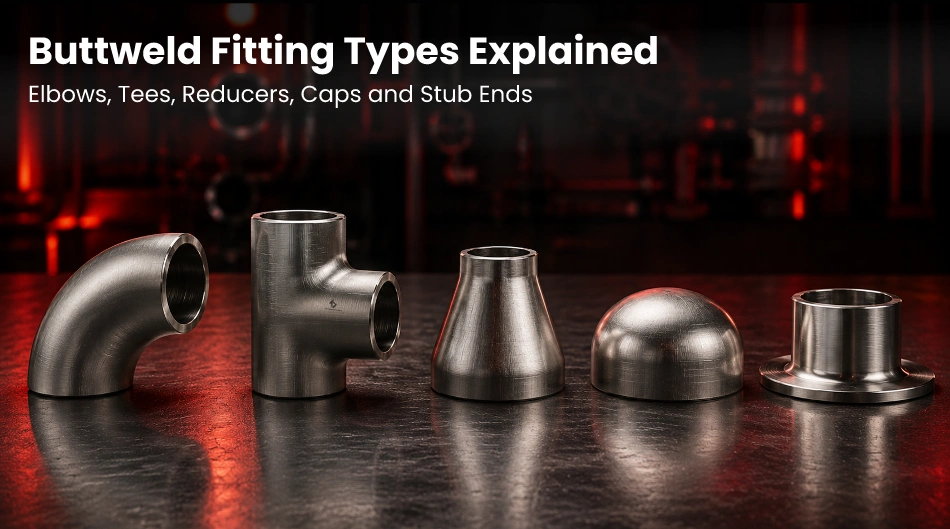
These Buttweld Fitting Types perform essential functions involving pipeline transitions, closures, and flange assemblies.
Concentric Reducers
Concentric reducers gradually decrease pipe diameter while maintaining a common centreline. Their symmetrical design minimises turbulence, making them ideal for vertical pipelines and pump discharge systems.
Eccentric Reducers
Eccentric reducers feature one flat side, preventing air pockets or liquid accumulation during horizontal installation. They are commonly specified on pump suction lines to reduce cavitation risks and maintain continuous flow.
Pipe Caps
Pipe caps permanently close the end of a pipeline during future expansion, maintenance shutdowns, or system termination. Properly welded caps provide leak-proof sealing while protecting internal pipe surfaces from contamination and corrosion.
Stub Ends
Stub ends are used together with lap joint flanges, allowing easy flange alignment and simplified maintenance. Because the flange rotates independently around the stub end, installation becomes quicker and future dismantling requires less effort.
Long and short stub ends are selected according to flange type, pressure class, and piping specifications.
ASME B16.9 Dimensional Standards at a Glance
One of the most important references governing Buttweld Fitting Types is ASME B16.9, which establishes dimensional requirements for factory-manufactured wrought buttwelding fittings.
The standard specifies:
Compliance with ASME B16.9 enables engineers to integrate fittings from qualified manufacturers without dimensional compatibility issues, supporting safe installation and consistent pipeline performance.
Depending on project requirements, fittings may also comply with related specifications such as ASME B16.28, MSS SP-43, ASTM A234, ASTM A403, ASTM A420, ASTM A815, and ASTM B366 for different material grades and service conditions.
Choosing the Right Buttweld Fitting Type
Selecting the correct fitting involves more than matching pipe size. Engineers typically consider:
Working with experienced manufacturers ensures that fittings are supplied with complete material traceability, dimensional compliance, and quality documentation, including Positive Material Identification (PMI), Hydrostatic Testing, Ultrasonic Testing (UT), Radiographic Testing (RT), and EN 10204 3.1 Material Test Certificates, where specified.
Conclusion
Understanding Buttweld Fitting Types is fundamental to designing safe, efficient, and reliable industrial piping systems. From elbows that control flow direction to tees that distribute process fluids, reducers that manage pipe size transitions, caps that terminate pipelines, and stub ends that simplify flange connections, each fitting performs a distinct engineering function.
When specified according to ASME B16.9 and manufactured from appropriate materials, buttweld fittings enhance flow efficiency, reduce maintenance requirements, and improve the long-term reliability of critical piping infrastructure. Selecting the appropriate fitting type not only ensures compliance with international standards but also contributes to safer operations and improved lifecycle performance across industrial facilities.
Frequently Asked Questions (FAQs)
1. What are the main types of buttweld fittings used in industrial piping systems?
The principal Buttweld Fitting Types include elbows, tees, crosses, concentric reducers, eccentric reducers, caps, and stub ends. Each fitting performs a specific function, such as changing flow direction, creating branch connections, reducing pipe diameter, sealing pipeline ends, or facilitating lap joint flange assemblies. Selecting the appropriate fitting enhances hydraulic efficiency, pressure integrity, and long-term system reliability.
2. How do engineers choose the correct buttweld fitting for a piping application?
Engineers evaluate several design parameters, including pipe diameter, operating pressure, temperature, flow velocity, corrosion conditions, available installation space, and applicable ASTM and ASME standards. The appropriate fitting type is selected to optimise fluid flow, minimise pressure losses, reduce mechanical stress, and ensure compliance with project specifications.
3. Why are Long Radius elbows preferred over Short Radius elbows in many industrial applications?
Long Radius (LR) elbows incorporate a centreline radius of 1.5D, allowing a smoother change in flow direction that reduces turbulence, pressure drop, and erosion. Accordingly, Long Radius (LR) elbows are extensively specified for oil and gas, petrochemical, power generation, and process engineering applications where hydraulic efficiency, operational reliability, and long-term pipeline integrity are of paramount importance. Short Radius (SR) elbows are generally selected where installation space is limited.
4. Which international standards govern buttweld fittings?
Industrial Buttweld Fitting Types are commonly manufactured in accordance with ASME B16.9 for dimensional requirements, while material specifications are governed by standards such as ASTM A234, ASTM A403, ASTM A420, ASTM A815, and ASTM B366. Compliance with these internationally recognised standards ensures dimensional accuracy, pressure integrity, material consistency, and interchangeability across industrial piping systems.
5. Which industries rely most on buttweld fittings?
Buttweld fittings are extensively employed throughout the oil and gas, petrochemical, power generation, chemical processing, desalination, marine engineering, water treatment, pharmaceutical, food manufacturing, and infrastructure sectors. Their fully welded construction delivers exceptional structural integrity, leak-tight performance, and long-term operational reliability, making them ideally suited to high-pressure and elevated-temperature piping systems.

Our Location
Flat no 5, Swapna HSG Soc
Ltd., Charkop, Kandivali West,
Mumbai, Maharashtra, India.
400067