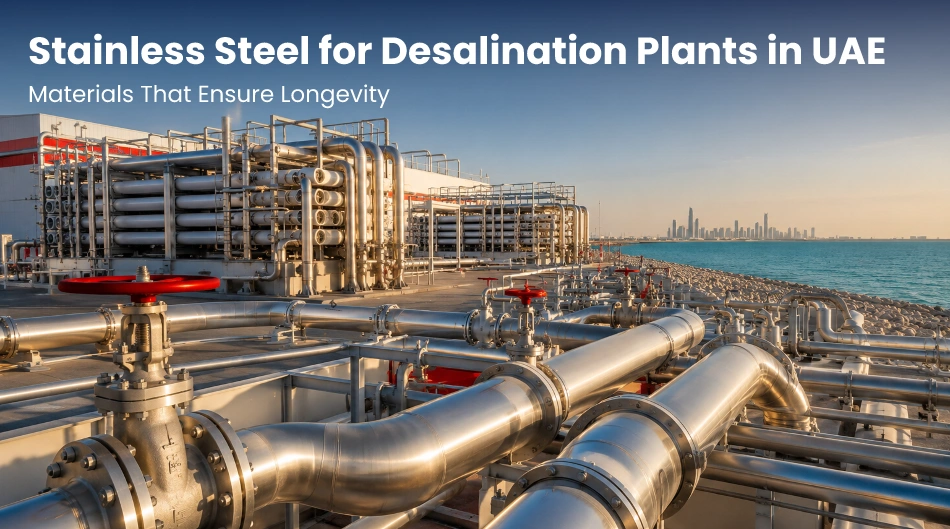
Materials Guide That Ensure Longevity
The United Arab Emirates is home to some of the world's most advanced desalination facilities, supplying millions of litres of potable water every day. Given the elevated concentrations of chlorides, dissolved salts, and other corrosive constituents present in seawater, the selection of an appropriate construction material represents one of the most critical engineering considerations during the design and development of desalination facilities. Stainless Steel for Desalination Plants in UAE must deliver exceptional corrosion resistance, mechanical strength, and long-term operational reliability while reducing maintenance costs and unplanned shutdowns.
Whether used in reverse osmosis (RO) plants, multi-stage flash (MSF) systems, or multi-effect distillation (MED) facilities, stainless steel continues to be the preferred material for pipelines, heat exchangers, pressure vessels, pumps, valves, and structural components operating in highly corrosive marine environments.
Why Material Selection Matters in UAE Desalination Plants
Desalination equipment continuously handles seawater containing chlorides, dissolved oxygen, biological organisms, and abrasive particles. These conditions expose metallic components to pitting corrosion, crevice corrosion, erosion-corrosion, and stress corrosion cracking.
Selecting an unsuitable material often leads to:
For this reason, engineers specify corrosion-resistant stainless steel grades capable of maintaining structural integrity throughout decades of continuous service.
Challenges Faced by Stainless Steel in Seawater Applications
The Gulf's marine environment presents unique engineering challenges that demand carefully selected alloys.
Major concerns include:
Modern desalination facilities therefore rely on stainless steels specifically engineered to resist aggressive seawater conditions without compromising mechanical performance.
Best Stainless Steel Grades for Desalination Plants
Not every stainless steel grade performs equally in desalination systems. Material selection is governed by several critical engineering considerations, including chloride concentration, operating temperature, design pressure, and the specific service environment in which the system is intended to operate.
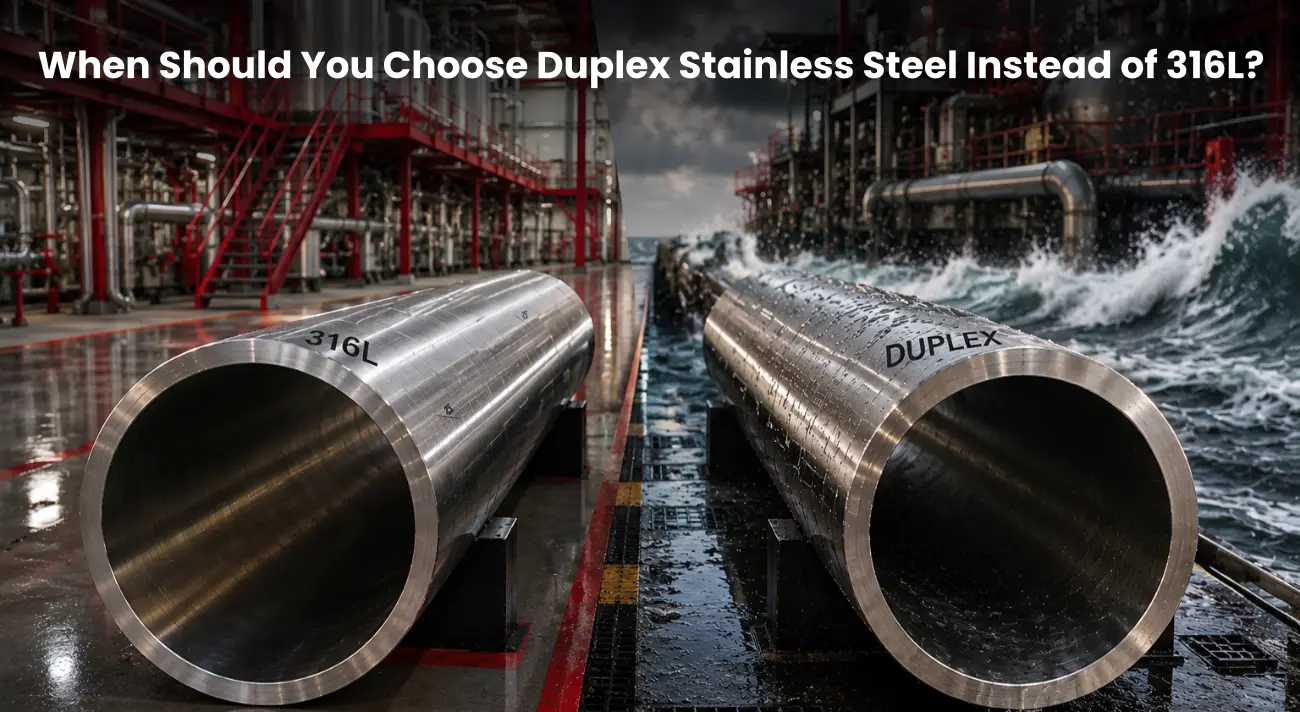
SS 316L
SS 316L remains one of the most widely specified stainless steels for moderate chloride environments. Its molybdenum content improves resistance to pitting and crevice corrosion compared with SS 304.
Typical applications include:
Duplex Stainless Steel (UNS S31803 / S32205)
Duplex stainless steel combines austenitic and ferritic microstructures, providing significantly greater strength and improved chloride resistance than conventional stainless steels.
Advantages include:
Duplex stainless steel is widely installed in:
Super Duplex Stainless Steel (UNS S32750 / S32760)
For extremely aggressive seawater service, Super Duplex stainless steel provides exceptional corrosion resistance together with outstanding structural performance.
It is commonly selected for:
Its superior pitting resistance equivalent number (PREN) makes it particularly suitable for chloride-rich environments.
Stainless Steel 904L
Stainless Steel 904L is characterised by elevated concentrations of nickel, chromium, molybdenum, and copper, imparting exceptional resistance to reducing acids, chloride-induced corrosion, pitting, crevice corrosion, and stress corrosion cracking in highly aggressive chemical environments.
Applications include:
254 SMO Stainless Steel
254 SMO is a high-alloy austenitic stainless steel developed specifically for severe seawater environments.
Its outstanding resistance to:
makes it one of the premium choices for demanding desalination facilities.
Stainless Steel Components Used in Desalination Plants
A modern desalination facility incorporates stainless steel throughout the entire process.
Typical components include:
Each component must comply with international engineering specifications to ensure long-term reliability.
International Standards for Desalination Materials
Leading desalination projects specify products manufactured in accordance with internationally recognised standards, including:
Compliance with these standards ensures dimensional consistency, mechanical reliability, material traceability, and pressure integrity throughout the plant lifecycle.
How Engineers Select Stainless Steel for Desalination Projects
Material selection extends beyond corrosion resistance alone.
Engineers evaluate:
Selecting the appropriate alloy at the design stage significantly reduces operational risks while improving plant availability.
Why UAE Desalination Projects Prefer Premium Stainless Steel
The UAE continues to invest heavily in sustainable water infrastructure to support population growth and industrial development. Premium stainless steel grades have become the preferred solution because they offer:
These advantages make Duplex, Super Duplex, SS 904L, and 254 SMO preferred materials for many critical desalination applications.
Choosing a Reliable Stainless Steel Supplier in the UAE
Selecting the right supplier is equally important as choosing the correct material. Industrial buyers should look for suppliers offering:
A technically competent supplier can help EPC contractors, consultants, and plant operators select materials that maximise safety, performance, and long-term value.
Conclusion
The success of a desalination plant depends heavily on selecting materials capable of withstanding one of the world's most demanding operating environments. Stainless Steel for Desalination Plants in UAE must provide exceptional resistance to chlorides, seawater corrosion, thermal stress, and continuous mechanical loading while maintaining long-term reliability.
From SS 316L for moderate service conditions to Duplex Stainless Steel, Super Duplex Stainless Steel, SS 904L, and 254 SMO for highly aggressive environments, each alloy offers distinct engineering advantages based on application requirements. By combining internationally recognised standards, rigorous quality assurance, and expert material selection, desalination facilities can achieve greater operational efficiency, reduced maintenance, and a significantly longer service life—ensuring a dependable supply of fresh water for the UAE's future.
Frequently Asked Questions (FAQs)
1. Which stainless steel grade is best suited for desalination plants in the UAE?
The most suitable stainless steel grade depends on the operating conditions, chloride concentration, temperature, and pressure of the desalination system. SS 316L is widely specified for applications involving moderate chloride exposure, whereas Duplex Stainless Steel, Super Duplex Stainless Steel, SS 904L, and 254 SMO are preferred for highly aggressive seawater environments owing to their outstanding resistance to pitting, crevice corrosion, and chloride-induced stress corrosion cracking. Engineers typically select the material based on project specifications, international standards, and the expected service life of the facility.
2. Why is Duplex Stainless Steel widely specified for desalination projects in the UAE?
Duplex Stainless Steel is extensively specified for desalination facilities across the UAE owing to its exceptional combination of high mechanical strength and outstanding resistance to corrosion. Its superior performance in chloride-rich seawater environments enables it to withstand aggressive marine conditions, elevated operating pressures, and continuous process demands with remarkable reliability. Consequently, its use contributes to reduced maintenance requirements, enhanced operational efficiency, and a prolonged service life for critical infrastructure, including pipelines, pressure vessels, pumps, and process equipment.
3. Which Stainless Steel Products Are Commonly Specified for Desalination Plants?
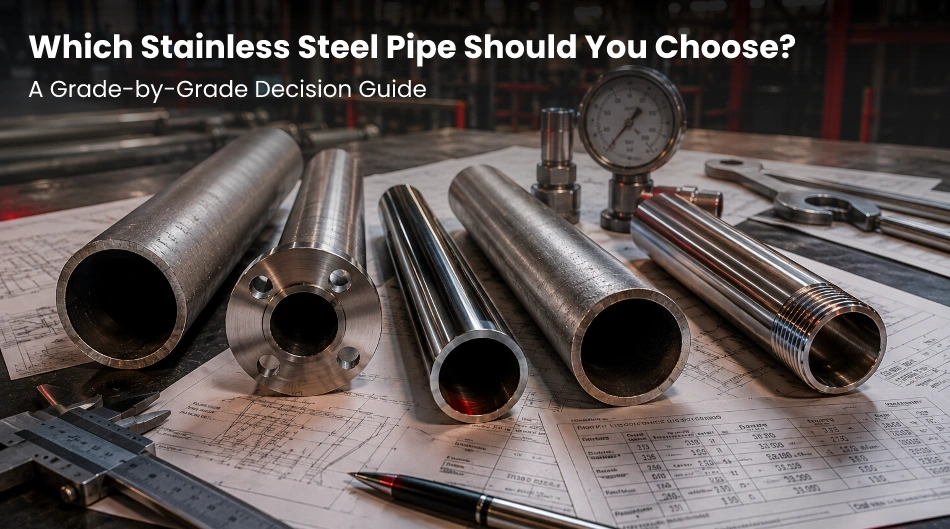
Modern desalination facilities incorporate a comprehensive range of stainless steel products, including seamless and welded pipes, tubes, buttweld fittings, forged fittings, flanges, heat exchanger tubes, condenser tubes, valves, pump components, and pressure vessels. These components are manufactured in strict accordance with internationally recognised ASTM and ASME standards to ensure superior corrosion resistance, dimensional precision, mechanical integrity, and long-term operational reliability under the demanding conditions associated with seawater treatment and desalination processes. Their robust performance supports the safe, efficient, and uninterrupted operation of critical water infrastructure throughout the facility.
4. What factors should engineers consider when selecting stainless steel for desalination applications?
Material selection should be based on a comprehensive evaluation of chloride concentration, operating temperature, system pressure, flow velocity, corrosion resistance, weldability, fabrication requirements, mechanical strength, and lifecycle cost. Selecting the appropriate stainless steel grade at the design stage enhances plant efficiency, minimises maintenance expenditure, and ensures reliable long-term operation under demanding seawater service conditions.
5. Why is material quality important for the longevity of UAE desalination plants?
High-quality stainless steel manufactured to recognised ASTM and ASME specifications provides superior resistance to seawater corrosion, erosion, and mechanical stress. Products supplied with Mill Test Certificates (EN 10204 3.1), Positive Material Identification (PMI), and comprehensive quality inspections help ensure compliance with international engineering standards, reduce the risk of premature component failure, and maximise the operational lifespan of desalination infrastructure across the UAE.

Our Location
Flat no 5, Swapna HSG Soc
Ltd., Charkop, Kandivali West,
Mumbai, Maharashtra, India.
400067