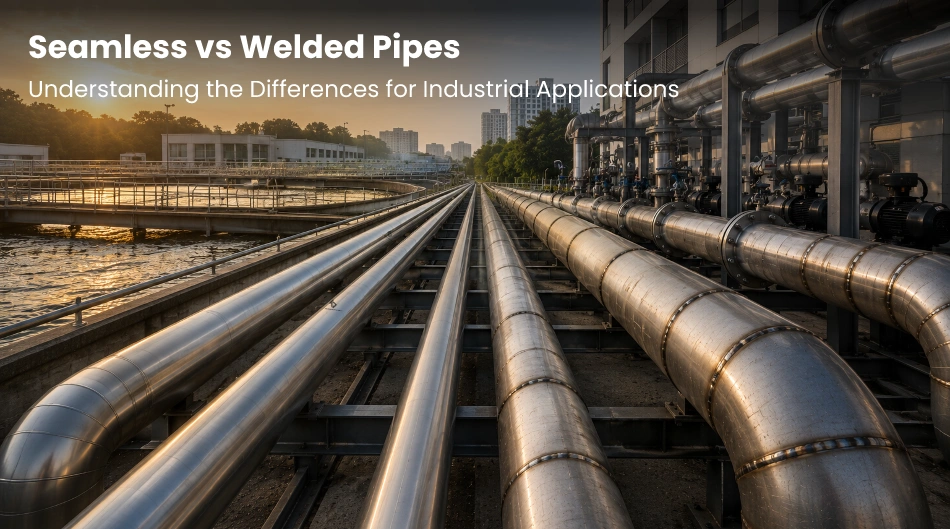
Seamless vs Welded Pipes: Understanding the Differences for Industrial Applications
Industrial piping systems form the backbone of sectors such as oil and gas, petrochemicals, power generation, desalination, marine engineering, water treatment, and heavy manufacturing. Selecting the appropriate pipe type is not simply a procurement decision; it directly influences system safety, operational efficiency, maintenance requirements, and long-term asset performance.
One of the most common engineering questions is Seamless vs Welded Pipes. Although both are manufactured to internationally recognised ASTM, ASME, and API standards, their manufacturing methods, mechanical characteristics, operating capabilities, and application suitability differ considerably. Understanding these differences enables engineers, EPC contractors, procurement specialists, and industrial buyers to specify the most appropriate piping solution for each project.
What Are Seamless Pipes?
Seamless pipes are manufactured by heating a solid cylindrical billet and piercing it to form a hollow tube, resulting in a continuous structure without a longitudinal welded seam. The pipe is subsequently elongated, rolled, and heat-treated to achieve the required dimensions and mechanical properties.
Because seamless pipes contain no longitudinal weld, they exhibit uniform grain structure throughout the pipe wall, making them particularly suitable for applications involving elevated pressures, high temperatures, and cyclic loading.
Seamless pipes are commonly manufactured in stainless steel, carbon steel, alloy steel, duplex stainless steel, super duplex stainless steel, nickel alloys, titanium, copper nickel, and other corrosion-resistant materials.
What Are Welded Pipes?
Welded pipes are produced by forming flat steel plate or strip into a cylindrical shape and joining the edges through a controlled welding process. Depending on the manufacturing technique, welded pipes may be produced as Electric Resistance Welded (ERW), Electric Fusion Welded (EFW), Longitudinal Submerged Arc Welded (LSAW), or Spiral Submerged Arc Welded (SSAW).
Advances in modern welding technology, automated inspection systems, and non-destructive testing have significantly improved weld integrity, enabling welded pipes to satisfy the performance requirements of numerous industrial applications.
Seamless vs Welded Pipes: Key Differences
Manufacturing Process
The principal distinction lies in the manufacturing process. Seamless pipes are produced from solid billets without welded joints, whereas welded pipes are fabricated by joining formed steel plate or strip using specialised welding techniques.
This manufacturing difference influences mechanical performance, dimensional consistency, production capacity, and overall project economics.
Pressure Performance
Seamless pipes are generally preferred for applications involving elevated internal pressure because their continuous wall structure eliminates the presence of a longitudinal weld.
Welded pipes also provide excellent pressure performance when manufactured and inspected in accordance with applicable ASTM, ASME, and API specifications. For many medium- and high-pressure industrial systems, modern welded pipes deliver dependable operational performance.
Diameter Availability
One significant advantage of welded pipes is their availability in considerably larger diameters.
While seamless pipes are commonly manufactured in standard industrial sizes, welded pipe manufacturing enables the production of very large diameters required for transmission pipelines, desalination plants, district cooling networks, offshore infrastructure, and water distribution systems.
Dimensional Accuracy
Modern welded pipe manufacturing offers exceptional dimensional consistency, particularly for outside diameter and wall thickness.
Seamless pipes may exhibit slightly greater dimensional variation owing to the hot-forming process, although both product types remain fully compliant with applicable international standards.
Cost Considerations
Manufacturing seamless pipes requires specialised piercing, rolling, heat treatment, and finishing operations, making production comparatively more expensive.
Welded pipes generally provide a more economical solution, particularly for larger diameters and long pipeline installations where cost efficiency is an important project consideration.
Inspection Requirements
Both seamless and welded pipes undergo comprehensive quality verification before supply.
Typical inspection procedures include:
These inspections ensure compliance with internationally recognised engineering standards.
When Should Seamless Pipes Be Selected?
Seamless pipes are generally specified when projects require:
Their uniform wall structure contributes to excellent pressure-bearing capability and long-term mechanical reliability under demanding operating conditions.
When Are Welded Pipes the Better Choice?
Welded pipes are often selected when projects require:
Modern welded pipe technology delivers reliable performance while offering significant economic advantages for large-scale industrial projects.
Material Grades Available in Both Pipe Types
Both seamless and welded pipes are manufactured in a broad range of engineering materials, including:
Material selection should always reflect operating temperature, corrosion environment, pressure requirements, process media, and applicable engineering specifications.
Factors to Consider Before Selecting Pipe Type
The selection of seamless or welded pipes should be guided by a comprehensive evaluation of operating conditions, design requirements, and applicable engineering standards, rather than by the manufacturing method alone.
Key considerations include:
Evaluating these factors ensures that the selected piping system satisfies both technical and commercial objectives.
Which Pipe Type Offers Better Long-Term Value?
Neither seamless nor welded pipes can be considered universally superior.
Seamless pipes remain the preferred solution for highly demanding pressure and temperature applications where maximum structural continuity is required.
Conversely, welded pipes provide excellent mechanical performance, superior availability in larger diameters, and greater cost efficiency for numerous industrial applications.
The most appropriate selection depends on project-specific operating conditions, engineering requirements, and lifecycle expectations rather than manufacturing method alone.
Conclusion
The comparison between Seamless vs Welded Pipes extends beyond manufacturing techniques. Each pipe type has been developed to address distinct engineering requirements, and both play an essential role in modern industrial infrastructure.
Seamless pipes offer exceptional pressure-bearing capability, structural uniformity, and reliable performance in high-temperature process systems. Welded pipes provide outstanding dimensional consistency, economic advantages, and the flexibility to manufacture large-diameter piping for extensive industrial networks.
For engineers, procurement professionals, and EPC contractors, the optimum choice should always be based on operating conditions, applicable international standards, corrosion environment, inspection requirements, and total lifecycle performance. A specification-driven approach ensures safe, efficient, and reliable piping systems capable of supporting long-term industrial operations across diverse sectors.
Frequently Asked Questions (FAQs)
1. What is the primary difference between seamless and welded pipes?
The principal difference lies in their manufacturing process. Seamless pipes are produced from a solid billet without a welded joint, providing a uniform microstructure and excellent performance under high-pressure and high-temperature conditions. Welded pipes are manufactured by forming steel plate or strip into a cylindrical shape and joining the edges using controlled welding techniques. Modern welded pipes comply with internationally recognised ASTM, ASME, and API standards, making them suitable for a wide range of industrial applications.
2. When should seamless pipes be selected instead of welded pipes?
Seamless pipes are generally specified for applications involving elevated operating pressures, high temperatures, cyclic loading, and critical process conditions. They are widely used in refineries, petrochemical plants, power generation facilities, boiler systems, heat exchangers, and pressure vessels, where structural continuity and long-term mechanical reliability are essential engineering requirements.
3. Are welded pipes suitable for high-pressure industrial applications?
Yes. Modern welded pipes are extensively used in industrial piping systems when manufactured and inspected in accordance with recognised ASTM, ASME, and API specifications. They offer excellent dimensional consistency, reliable mechanical performance, and cost-effective solutions for oil & gas transmission, water treatment, district cooling, desalination plants, structural applications, and large-diameter pipeline networks. The suitability of welded pipes should always be determined by the project's operating pressure, temperature, and applicable design standards.
4. What factors should engineers consider when choosing between seamless and welded pipes?
Material selection should be based on a comprehensive engineering evaluation that considers operating pressure, service temperature, corrosion environment, pipe diameter, wall thickness, process fluid, fabrication requirements, inspection criteria, applicable international standards, and expected service life. Assessing these technical and operational parameters helps ensure the selected piping solution delivers optimum performance, regulatory compliance, and long-term operational reliability.
5. Which industries commonly use both seamless and welded pipes?
Both seamless and welded pipes are extensively specified across oil & gas processing, petrochemical manufacturing, power generation, chemical processing, desalination, marine engineering, water transmission, infrastructure development, district cooling, and industrial process piping. The selection should ultimately be guided by the application's mechanical requirements, operating conditions, project specifications, and expected service life, rather than by the manufacturing method alone.

Our Location
Flat no 5, Swapna HSG Soc
Ltd., Charkop, Kandivali West,
Mumbai, Maharashtra, India.
400067