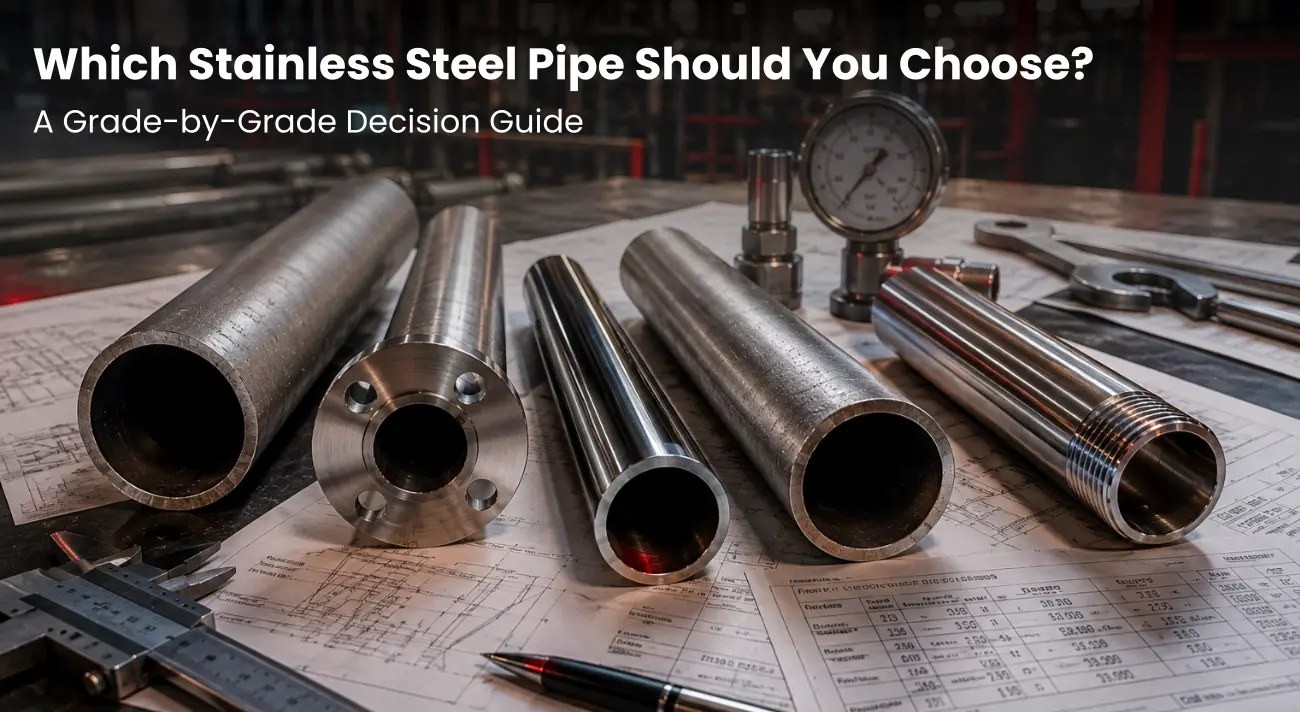
Choose the right stainless steel pipe grade based on application, corrosion resistance, strength, and temperature.
Choosing the right stainless steel pipe is not simply a matter of selecting the most corrosion-resistant or expensive grade. The correct choice depends on the application, operating temperature, pressure, corrosion exposure, pipe dimensions, manufacturing method, applicable standards and required certifications.
For engineers, contractors and procurement teams, understanding how these factors work together can prevent premature corrosion, unnecessary costs, installation problems and material failures.
This guide explains how to select the appropriate stainless steel pipe by evaluating the complete specification, rather than relying on material grade alone.
What Should You Consider Before Choosing a Stainless Steel Pipe?
Before ordering stainless steel pipes, establish the following technical and application-specific requirements:
A pipe that performs well in one application may not be appropriate for another. For example, a general industrial installation may not require the same corrosion resistance or temperature performance as a chemical processing or high-temperature system.
1. Choose the Stainless Steel Grade According to the Application
The stainless steel grade influences key performance characteristics, including corrosion resistance, temperature tolerance, weldability and suitability for the intended service conditions.
SS 321 and SS 347: For Elevated-Temperature Service
When temperature becomes a major design factor, conventional grades may not provide the required performance.
SS 321 and SS 347 are stabilized austenitic stainless steels commonly considered for elevated-temperature applications.
SS 321 uses titanium stabilization, while SS 347 uses niobium stabilization. SS 347 is particularly associated with high-temperature industrial service, thermal cycling and applications such as boilers, heat exchangers, refineries and petrochemical systems.
Choose a stabilized grade when:
SS 310: For High-Temperature Environments
SS 310 is commonly considered where oxidation resistance and high-temperature performance are major requirements.
It can be relevant to furnace equipment, heat-treatment systems and other high-temperature industrial processes.
SS 904L: For Highly Corrosive Environments
SS 904L is a high-alloy stainless steel used where more demanding corrosion resistance is required.
It may be considered for aggressive chemical-processing environments where standard austenitic grades are not sufficient for the service conditions.
Important: Grade selection should always be based on the actual process conditions and applicable engineering specification rather than choosing a grade simply because it has a higher price or alloy content.
2. Decide Between Seamless and Welded Stainless Steel Pipe
Grade is only one part of pipe selection. The manufacturing method also matters.
Seamless Stainless Steel Pipe
Seamless pipes are manufactured without a longitudinal welded seam and are frequently selected for demanding pressure and temperature applications.
They may be appropriate where the project specification requires seamless construction or where pressure integrity is a critical consideration.
Welded Stainless Steel Pipe
Welded pipes are manufactured by forming stainless steel material and joining it through a welding process.
They can offer cost and manufacturing advantages and are widely used in industrial applications where welded construction meets the engineering requirements.
Do not automatically assume that seamless is always better. The appropriate choice should be determined by the design pressure, operating temperature, pipe diameter, service conditions, applicable standards and project-specific requirements.
3. Select the Correct Pipe Size and Wall Thickness
Choosing the correct diameter is essential for maintaining required flow and system performance.
Consider:
Wall thickness should not be selected simply because a thicker pipe appears stronger. It should be established according to the design conditions and applicable engineering code.
4. Understand Stainless Steel Pipe Schedule
Pipe schedule is another important specification when selecting stainless steel piping.
Common schedules include:
The schedule relates to wall thickness for a given nominal pipe size. A higher schedule generally means a thicker wall, but the appropriate schedule must be determined from the pressure, temperature, diameter, corrosion allowance and applicable design standard.
The appropriate pipe schedule should be selected based on the specific engineering requirements of the application, including operating pressure, temperature, pipe diameter, wall thickness and applicable standards, rather than simply choosing the highest schedule.
KVN Steels' pricing guide also identifies outside diameter, wall thickness, schedule and pipe length as important factors affecting stainless steel pipe selection and cost.
5. Check the Required Stainless Steel Pipe Standard
A stainless steel pipe specification should clearly identify the applicable standard.
Depending on the product and application, buyers may encounter standards such as:
For example, KVN's SS 316 content identifies ASTM A312 TP316 for pipes and ASTM A213 TP316 for tubes.
The material grade alone is therefore not enough. A procurement specification should identify the material, product form, dimensions, manufacturing method and applicable standard.
6. Choose the Appropriate Surface Finish
Surface finish can influence appearance, cleanliness, fabrication and suitability for particular applications.
Common finishes include:
For hygienic applications such as food processing and pharmaceutical facilities, surface condition can be especially important because smooth, cleanable surfaces can support sanitation requirements.
For industrial piping, however, finish should be specified according to the actual application and project requirements rather than appearance alone.
7. Ask for Testing and Material Certification
For industrial procurement, documentation is as important as the physical pipe.
Depending on the project, buyers may need:
A reliable supplier should be able to provide documentation appropriate to the product and project specification.
KVN Steels states that its technical support includes material selection, product specifications, international standards, sizing recommendations, documentation and project-specific requirements.
Stainless Steel Pipe Selection: Quick Decision Guide
| Requirement | Suitable consideration |
|---|---|
| General-purpose industrial application | SS 304 |
| Marine or chloride exposure | SS 316 |
| Elevated-temperature service | SS 321 / SS 347 |
| High-temperature processing | SS 310 |
| Aggressive chemical environment | SS 904L |
| High-pressure application | Consider seamless construction where specified |
| Cost-sensitive general application | Consider welded construction where permitted |
| Hygienic application | Specify appropriate surface finish |
| Critical industrial project | Verify standards, testing and certification |
This table should be treated as a starting point, not a substitute for engineering calculations or project specifications.
How to Choose the Right Stainless Steel Pipe: Final Checklist
Before placing an order, verify:
Where to Buy Stainless Steel Pipes and Tubes
Selecting the right pipe is only half of the procurement decision. The supplier should also be able to provide the required material grade, dimensions, manufacturing type, standards and documentation.
KVN Steels supplies industrial pipes and tubes and supports applications across sectors including oil & gas, petrochemical, marine engineering, power generation, desalination, water treatment and industrial manufacturing. Its technical team also supports material selection, specifications, sizing and project-specific requirements.
Explore the Stainless Steel Pipes and Tubes range from KVN Steels to review available piping solutions for industrial applications.
Conclusion
Choosing a stainless steel pipe should be treated as an engineering and procurement decision, not simply a grade comparison.
The right solution combines the appropriate stainless steel grade, pipe construction, dimensions, schedule, standard, surface finish and certification with the actual operating conditions.
Whether the application involves general industrial service, corrosive conditions, marine exposure or elevated temperatures, defining these parameters before procurement helps minimise specification errors and ensures reliable long-term piping performance.
For industrial projects requiring stainless steel pipes and tubes, KVN Steels can support the selection process with product specifications, material options, sizing guidance and project-specific documentation.
Frequently Asked Questions (FAQs)
Which stainless steel pipe is best for industrial applications?
There is no single stainless steel pipe grade that is best for every industrial application. The appropriate choice depends on the service environment, corrosion exposure, operating temperature and pressure, pipe dimensions, manufacturing method and applicable standards. SS 304 may suit general-purpose applications, while SS 316 or higher-alloy grades may be more appropriate for corrosive or specialised environments.
How do I determine the right grade of stainless steel pipe for an application?
Select the stainless steel grade according to the conditions in which the pipe will operate. Consider the type and concentration of corrosive media, chloride exposure, operating temperature and pressure, mechanical requirements, weldability and applicable industry standards. The grade should be selected based on the complete service specification rather than cost or corrosion resistance alone.
What factors should be considered when selecting a stainless steel pipe?
Key selection factors include material grade, application, corrosion resistance, operating temperature, pressure, nominal pipe size, wall thickness, pipe schedule, seamless or welded construction, applicable standards, surface finish and certification requirements. Considering these factors together helps ensure that the pipe is suitable for its intended service.
Should I choose seamless or welded stainless steel pipe for my application?
The choice between seamless and welded stainless steel pipe should be based on the application, design pressure, operating temperature, pipe dimensions, service conditions and applicable specifications. Seamless stainless steel pipe is generally preferred for high-pressure, high-temperature, and other critical-service applications. Welded pipe can be a practical alternative for many industrial systems when permitted by the applicable pipe standard, design requirements, and operating conditions.
Which stainless steel pipe grade is suitable for marine applications?
SS 316 is widely used in marine and chloride-containing environments because its molybdenum addition improves resistance to pitting and crevice corrosion compared with SS 304. The final grade, however, should be selected according to chloride levels, operating temperature, exposure conditions, corrosion risk, applicable standards, and project-specific requirements.
How do I determine the appropriate stainless steel pipe schedule for my application?
Pipe schedule should be selected according to the required wall thickness for the pipe size and the system's design conditions. Operating pressure, temperature, nominal diameter, material properties, corrosion allowance and applicable design codes should be considered before specifying a schedule such as Schedule 10, 40, 80 or 160.
What stainless steel pipe standards should I check?
The applicable standard depends on the pipe type, material, application and project requirements. Common standards include ASTM, ASME, API and EN specifications. The purchase specification should clearly identify the material grade, product form, manufacturing method, dimensions and relevant standard rather than specifying the grade alone.
What information is required when ordering stainless steel pipes?
A stainless steel pipe enquiry should normally include the material grade, pipe type, manufacturing method, nominal size or outside diameter, wall thickness or schedule, required length and applicable standard. Depending on the project, the specification may also need to include surface finish, testing, inspection and material certification requirements.
What certification should I request when buying stainless steel pipes?
The required documentation depends on the application and procurement specification. It may include a Mill Test Certificate (MTC), chemical and mechanical test results, heat-number traceability, hydrostatic testing records, inspection reports and certificates issued in accordance with the specified standard, such as EN 10204 documentation where applicable.
Is a thicker stainless steel pipe always better?
No. A thicker pipe is not automatically the better choice. Wall thickness should be determined by the design pressure, temperature, pipe diameter, corrosion allowance, mechanical requirements and applicable engineering standards. Selecting an unnecessarily thick pipe can increase material cost and weight without providing a corresponding technical benefit.
How can I avoid choosing the wrong stainless steel pipe?
Start by defining the operating conditions and technical requirements before selecting the material. Confirm the grade, pipe construction, dimensions, schedule, standard, surface finish and certification requirements. Providing these details to the supplier at the enquiry stage reduces specification errors and helps ensure that the supplied pipe meets the project's requirements.

Our Location
Flat no 5, Swapna HSG Soc
Ltd., Charkop, Kandivali West,
Mumbai, Maharashtra, India.
400067