Alloy Designation :
Ti-6Al-4V


Alloy Designation :
Ti-6Al-4V
UNS Designation :
R56400
Werkstoff Number :
3.7165
Alloying Elements :
Aluminum–Vanadium Composition


Titanium Grade 5 Forged Fittings are engineered from a titanium alloy composed primarily of titanium, with approximately 6% aluminum and 4% vanadium. Known as Ti-6Al-4V, this grade is widely regarded as the most versatile and high-performing among titanium alloys due to its exceptional combination of strength, toughness, and corrosion resistance. Forged fittings made from Titanium Gr 5 deliver superior mechanical performance under both static and dynamic load conditions, making them ideal for high-stress and high-temperature environments. With a tensile strength ranging between 900–1100 MPa and a density of around 4.43 g/cm³, these fittings offer an outstanding strength-to-weight ratio unmatched by many other industrial metals.
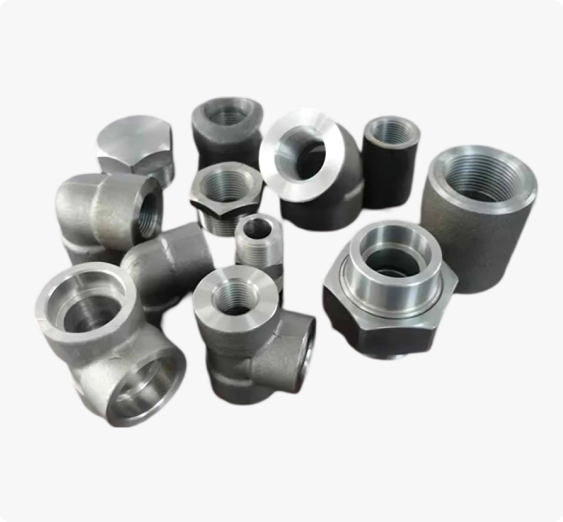
The forging process used to create Titanium Gr 5 fittings enhances their grain structure, mechanical integrity, and fatigue resistance. These forged components are precisely machined to offer tight dimensional tolerances, excellent sealing capabilities, and consistent performance even under extreme pressure and thermal cycling. They are manufactured in various configurations—including elbows, tees, crosses, couplings, unions, plugs, and bushings—to support a broad range of fluid control applications. Additionally, they comply with stringent international standards such as ASTM B381 and ASME SB381, ensuring global compatibility and high-performance consistency.
Beyond structural strength, Titanium Gr 5 Forged Fittings exhibit superior resistance to corrosive agents including chlorides, acids, alkalis, and seawater. The presence of aluminum and vanadium in the alloy contributes to enhanced thermal stability, making these fittings well-suited for systems operating in elevated-temperature or cryogenic conditions. Their low thermal expansion, non-magnetic nature, and long-term reliability further position Titanium Gr 5 as a preferred material for critical systems requiring both durability and weight optimization.
Applications
Forged fittings made from Titanium Grade 5 are highly sought after for applications that demand exceptional strength, reduced weight, and robust corrosion resistance in challenging operational environments. In the aerospace industry, these fittings are vital for hydraulic systems, fuel delivery lines, and structural components that demand reliability under fluctuating pressures and temperatures. Their ability to endure fatigue and thermal stress without compromising performance makes them a preferred choice in aircraft, spacecraft, and satellite systems. Their reduced weight plays a critical role in enhancing fuel economy and maximizing payload capacity within aerospace engineering applications.
In marine engineering, Titanium Gr 5 fittings are employed in propulsion systems, ballast systems, offshore platforms, and desalination units where constant exposure to aggressive saltwater and fluctuating temperatures demands a material with both corrosion and fatigue resistance. The oil and gas industry also relies heavily on Gr 5 Titanium forged fittings in upstream drilling rigs, subsea piping, and high-pressure refining systems. These components maintain structural integrity in the presence of hydrogen sulfide (H₂S), carbon dioxide (CO₂), and other corrosive gases found in sour service conditions.
Moreover, these fittings are widely used in chemical processing plants, where they are installed in pipelines and reactors that handle aggressive fluids such as chlorinated solvents, nitric acid, and sulfuric acid. Titanium Gr 5’s ability to resist chemical attack while retaining its mechanical properties ensures long service life and reduced maintenance costs. In power generation systems—including thermal, nuclear, and renewable energy—these forged fittings facilitate the safe and efficient transfer of high-temperature steam and chemically treated fluids, often under high pressure. Their stable performance in oxidizing and reducing conditions makes them particularly valuable in heat exchangers and condensate lines.
Industry Use and Global Supply
Titanium Grade 5 Forged Fittings are indispensable across industries that demand superior strength, low weight, and operational safety in challenging environments. In the defense sector, these fittings are integrated into armored systems, weapon platforms, and military aircraft, where performance, corrosion resistance, and long-term durability are critical. The automotive and motorsport industries also utilize Titanium Gr 5 in fuel systems, exhaust assemblies, and high-performance engine components, where weight reduction directly enhances speed and efficiency.
In the medical field, Titanium Gr 5 is widely used in surgical equipment, orthopedic implants, and sterile processing systems due to its biocompatibility and corrosion resistance. These forged fittings ensure sterile fluid transport in pharmaceutical manufacturing and laboratory environments, where system purity and material integrity are paramount. Additionally, high-tech industries—including electronics, semiconductors, and clean energy—depend on Titanium Gr 5 for ultra-pure fluid handling and gas delivery systems where contamination control and chemical stability are essential.
We are proud to supply Titanium Gr 5 Forged Fittings to key industrial hubs across India, the United Arab Emirates (UAE), the Kingdom of Saudi Arabia (KSA), Kuwait, Qatar, the Sultanate of Oman, Iran, and Iraq. Our supply chain is designed to meet the unique operational and compliance requirements of each market, delivering high-performance fittings with full traceability and quality assurance. From advanced aerospace innovations and green energy systems to essential industrial operations, Titanium Gr 5 Forged Fittings deliver exceptional durability, adaptability, and long-term performance across a broad spectrum of international applications.
| STANDARD | UNS | WNR. |
|---|---|---|
| Titanium Gr 5 | R56400 | 3.7165 |
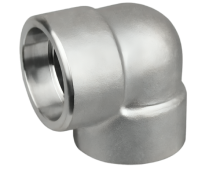
Socket-Weld Elbow Connection
A socket-weld elbow redirects piping through a compact welded joint, helping achieve secure directional changes in space-conscious installations.
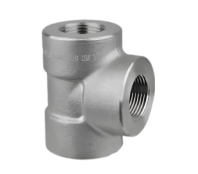
Forged Tee Branch
A forged tee branch divides or combines flow between connected pipe runs, providing a practical layout for branching process lines.
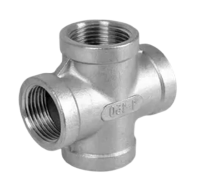
Four-Way Cross Fitting
A four-way cross fitting connects four pipe paths at one junction, supporting multi-directional routing in compact piping arrangements.
Full Coupling Connector
A full coupling connector joins two pipe ends, providing a straightforward solution for extending or assembling continuous piping runs.
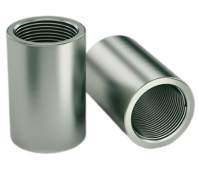
Half Coupling Connector
A half coupling connector attaches a pipe to a branch outlet or equipment port, creating a compact transition between different connections.
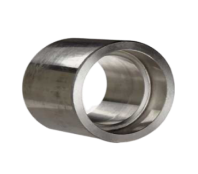
Forged Pipe End Cap
A forged pipe end cap closes an open line, helping isolate piping, protect the end, and prepare systems for maintenance or future extension.
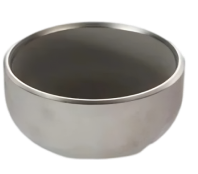
Forged Union Connector
A forged union connector provides a detachable pipe joint, allowing easier installation, inspection, servicing, and component replacement.
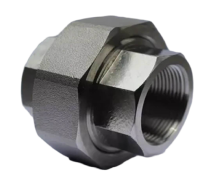
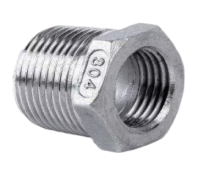
Reducing Bushing
A reducing bushing adapts a larger connection to a smaller one, enabling compact size transitions between piping components.
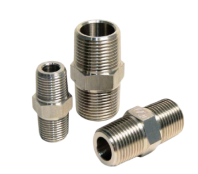
Forged Pipe Nipple
A forged pipe nipple provides a short connection between pipes, valves, fittings, or equipment where limited installation space is available.
Alloy Designation :
Ti-6Al-4V
UNS Designation :
R56400
Werkstoff Number :
3.7165
Alloying Elements :
Aluminum–Vanadium Composition
Strength Characteristic :
High strength-to-weight ratio
Temperature Capability :
Suitable for demanding elevated-temperature applications
Service Benefit :
Combines high strength with corrosion resistance
Typical Applications :
Aerospace, chemical processing, oil & gas and high-performance piping
Chemical Composition of Titanium Gr 5 Forged Fittings
| Al | Fe | O | Ti | V |
|---|---|---|---|---|
| 6 | 0.25 | 0.2 | 90 | 4 |
Mechanical Properties Of Titanium Grade 5 Forged Fittings
| Element | Density | Melting Point | Tensile Strength | Yield Strength (0.2%Offset) | Elongation |
|---|---|---|---|---|---|
| Titanium Gr. 5 | 4.43 g/cm3 | 1632 °C (2970 °F) | Psi – 138000 , MPa – 950 | Psi – 128000 , MPa – 880 | 14 % |
Physical Properties of Titanium Gr 5 Forged Fittings
| Physical Properties | Metric | English |
|---|---|---|
| Density | 4.43 g/cc | 0.16 lb/in³ |
Our Titanium Gr 5 Forged Fittings are used in a wide range of applications and various industries. Below are a few of them:

Application Industries

Aerospace Industry

Food Processing Industry

Pulp & Paper Indusry

Energy Industry

Pharmaceuticals Industry

Power Plant Industry

Chemical Industry

Oil and Gas Industry
Get clear answers to common queries about our steel products, services, and delivery processes.

Ti-6Al-4V, commonly known as Grade 5, combines high strength with relatively low density and good corrosion resistance. This balance makes it useful where weight, mechanical performance, and durability are important.
The principal alloying elements are approximately 6% aluminum and 4% vanadium. ASTM identifies Grade F-5 as UNS R56400 and specifies it as a titanium alloy containing these elements.
Grade 5 is generally considered when greater mechanical strength is needed than commercially pure grades can provide. The final choice should also account for temperature, corrosion conditions, fabrication requirements, and design loads.
Yes. Its combination of high strength and relatively low density gives Ti-6Al-4V a strong strength-to-weight profile. This is one reason the alloy is widely used in aerospace, chemical-processing, and other weight-sensitive engineering applications.
ASTM B381 / ASME SB381 is the relevant specification for titanium and titanium alloy forgings. ASTM B381 establishes requirements including chemical composition and applicable mechanical properties for covered forging grades.
Check the material documentation for UNS R56400, the applicable forging specification, chemical analysis, heat identification, mechanical test results, and required inspection records. A Material Test Certificate helps establish material traceability.
They can be considered for demanding piping duties where the combination of corrosion resistance, strength, and low weight is beneficial. Suitability should be established from the actual pressure, temperature, fluid chemistry, connection design, and applicable engineering code.
Depending on the component and project requirement, configurations can include socket-weld and threaded connections. Connection dimensions, pressure class, thread form, and applicable standards should be confirmed before ordering.
Inspection may include dimensional checks, chemical analysis, mechanical testing, visual or surface examination, and other nondestructive examinations where specified. ASTM B381 notes that purchaser-specified NDT can include ultrasonic testing, X-ray, or surface inspection.
A useful enquiry should include the component design, nominal size, connection type, quantity, material specification, pressure requirement, dimensional standard, testing requirements, certification needs, and delivery conditions. Complete information helps the supplier match the product to the project specification.

Our Location
Flat no 5, Swapna HSG Soc
Ltd., Charkop, Kandivali West,
Mumbai, Maharashtra, India.
400067


